

Your Production House Is Costing You More Than Money
There's a version of your brand film sitting on somebody's hard drive right now that you overpaid for. You know the one. Decent color grade. Some aerial drone shots of Mumbai at golden hour because of course there are drone shots. A motivational voiceover that could apply to literally any company in any industry on any continent. It cost ₹18 lakhs. It took eleven weeks. And your CEO watched the final cut, nodded politely, and never shared it.
That film didn't fail because your team had a bad idea. The idea was probably sharp. It failed because somewhere between the brief you wrote at midnight and the final export that landed in your inbox, the actual thought — the reason anyone would care — got sanded down into nothing by a process designed to protect mediocrity.
If you've worked with a production house in Mumbai in the last five years, you already know this feeling. You just might not have had the language for it yet.
The Broken Handoff
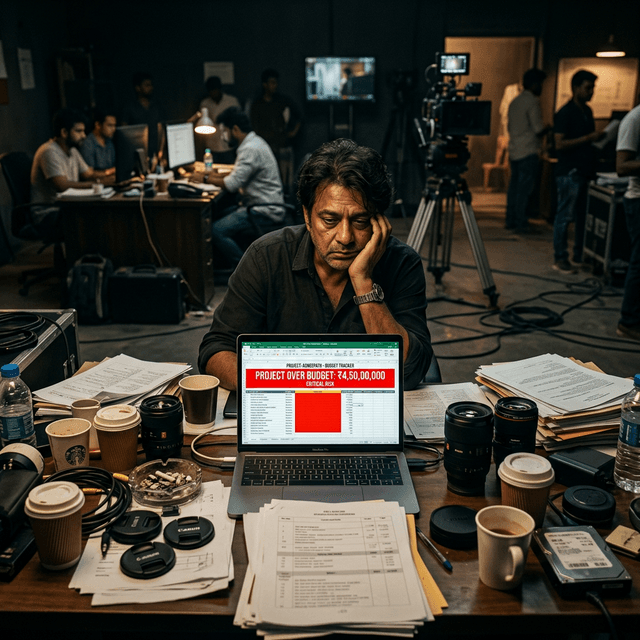
Here is how it usually works. You — the brand lead, the marketing manager, the person who actually understands the customer — write a brief. It might be rough. It might be a Google Doc with bullet points and a mood board screenshot from a Wes Anderson film. But the intent is there. You know what the piece needs to do.
That brief goes to your creative agency in Mumbai. An account manager reads it, sanitizes it, adds agency language, and turns it into a second document — the "creative brief." This version is polished. The edges are gone. The weird, specific thing your CMO said in the hallway about "making it feel like opening a letter from an old friend"? Deleted. Too subjective. Not actionable.
Then the agency briefs the production house. A third interpretation. The director reads the creative brief — not your original brief, not the hallway conversation, not the thing that made you excited in the first place — and builds a treatment around words that are two translations removed from the original impulse. By the time the cameras roll, the thing that made the idea special has been professionally extracted.
This is not incompetence. It's architecture. The three-party relay model between brand, agency, and production house was designed for an era of 30-second TV spots and 6-month campaign cycles. It worked when there was one deliverable and everyone had time to align. In 2025, it's structural sabotage. You need fifteen pieces of content from a single shoot. You need things to feel alive. And the game of telephone between three legal entities with three different incentive structures guarantees that nothing will feel alive.
The best production houses in Mumbai — the ones doing genuinely interesting work — have figured this out. They don't wait for the agency to hand them a shot list. They sit in the room when the idea is born. Or better yet, they are the room.
What Cinematic Evidence Actually Looks Like
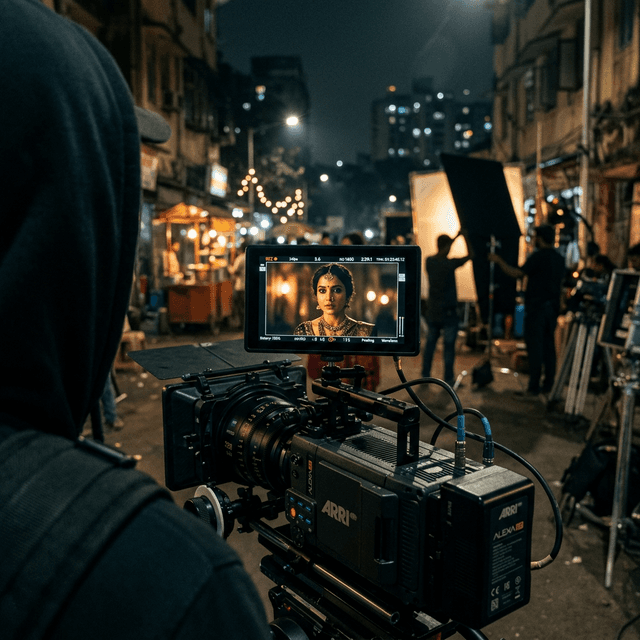
Every production house has a showreel. Showreels are useless. They are a greatest-hits compilation set to an emotional soundtrack designed to make you feel something — anything — long enough to sign a contract. The Kuleshov effect, weaponized for sales decks.
If you are evaluating a creative agency or production house in Mumbai, stop watching showreels. Instead, look for three things in their actual project work:
1. Does the opening frame earn the second? Pull up any brand film in their portfolio. Watch the first five seconds with the sound off. If the visual language doesn't immediately tell you something specific — a tension, a texture, a point of view — it's a template. Most brand films in Mumbai start with an establishing shot of a building or a slow-motion pour of a product. That's not directing. That's defaulting.
2. Is there an editorial opinion, or just execution? There's a difference between a well-shot film and one that has something to say. Look for brand films where the narrative structure has an actual argument. A before and after. A contrast. A reversal. If the entire piece is just "here's what we do and we're great at it," that's a brochure with a drone, not a film.
3. Does the same team also write? The single biggest predictor of whether a brand film will land is whether the people directing it were also involved in writing it. When the creative and the craft are in the same skull, you get coherence. When they're in different buildings, you get "we'll fix it in post."
The Format Problem Nobody Talks About
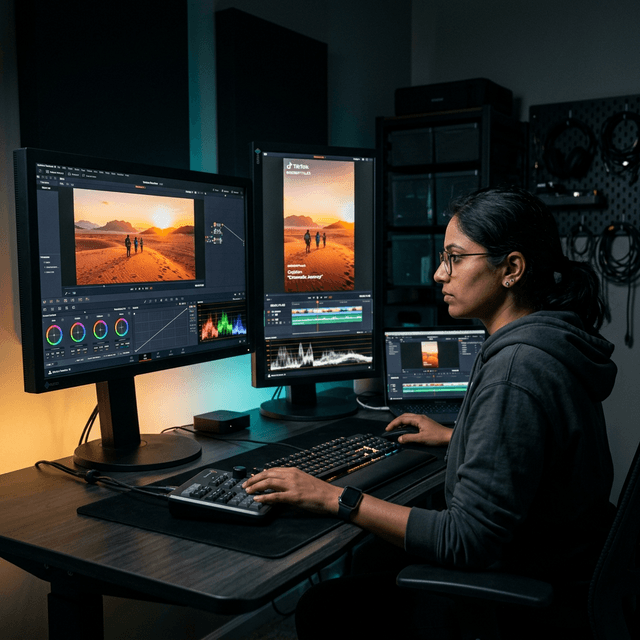
Let's talk about the most boring crisis in content production. Aspect ratios.
In 2026, a single shoot for a single campaign needs to produce content in 16:9 for YouTube pre-rolls and website heroes, 9:16 for Instagram Reels and YouTube Shorts, and 1:1 for carousel posts and LinkedIn. That's three fundamentally different compositions from the same footage. And here is where most production houses — even good ones — quietly fall apart.
The standard approach is to shoot wide, then crop in post. Which means your 9:16 vertical is just the center slice of a frame that was composed for horizontal. The result is predictable: medium shots become extreme close-ups, carefully balanced compositions collapse, and anything that existed in the left or right third of the frame disappears entirely. You paid for a cinematographer's eye, and then you threw away 60% of what that eye composed.
This is where the conversation about AI-first post-production workflows stops being a buzzword and starts being an operational necessity. Modern computational reframing tools can analyze footage shot in one aspect ratio and intelligently recompose it for another — tracking subjects, maintaining headroom, preserving the compositional intent of the original frame. But this only works if the production house shoots with multi-format delivery as a first-class concern, not an afterthought. That means wider coverage, strategic framing margins, and a post-production pipeline that treats 9:16 as a primary deliverable — not a junior editor's Friday afternoon task.
Most traditional production houses in Mumbai still treat vertical as a crop job. The ones building for 2026 treat it as a parallel creative output. The difference shows in every frame.
The production house model isn't broken because the people inside it are bad at their jobs. It's broken because the model was designed for a media landscape that doesn't exist anymore. If you are still separating creative thinking from production execution, you are paying twice — once for the idea and once for its funeral.
If any of this sounded uncomfortably familiar, we should probably talk. No pitch decks. No account managers. Just a conversation about what your brand actually needs. Write to us at the Director's Desk.